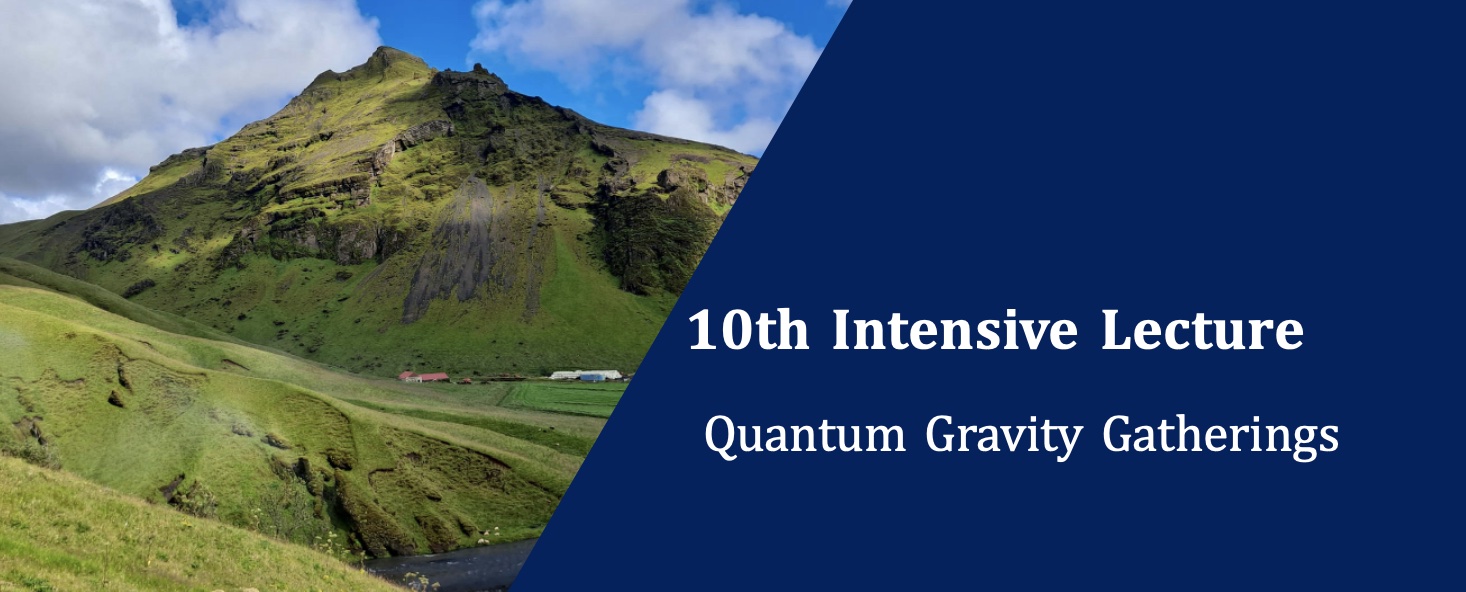
ODEs, CFTs and QNMs of black holes
24–26 February 2026 @ RIKEN, Wako, Japan
Because of circumstances beyond our control, we have found that it will be difficult to hold the announced lecture as originally planned. We will reorganize the program, and if the new schedule has been finalized, we will make another announcement. We sincerely apologize to those who have already registered. Thank you for your understanding.
In the tenth event of the Intensive Lecture Series, organized by the Quantum Gravity Gatherings (QGG) study group at RIKEN iTHEMS, we will have Prof. Yasuyuki Hatsuda from Rikkyo University, who will deliver a three-day lecture series on the analytic methods in black hole perturbation theory .
Black hole perturbation theory plays a very important role in the developments of modern physics. For instance, in gravitational wave astronomy, it can describe the ringdown phase during the merger events of binary black holes. As the frequency and decay rate of each quasinormal mode are unique to the remnant black hole, one can test extreme-gravity physics by extracting those modes from the ringdown signal. In addition, the computations of black hole quasinormal modes based on black hole perturbation theory has relations connecting to conformal field theories and even to the computations of tidal Love numbers. With the broad applications, we expect this lecture series to provide fresh perspectives to researchers across a wide range of fields and to inspire new directions in their own research.
The lectures will be delivered in a blackboard-style format (in English), designed to foster interaction, active participation, and in-depth Q&A discussions. In addition, short talk sessions will be held, giving participants the opportunity to present briefly on topics of their choice. Through this informal and dynamic setting, we hope to spark active interactions among participants and create an environment where ideas can be shared openly and enthusiastically.
Registration
Registration Form
- Deadline: January 23.
(If the number of registered participants exceeds the room capacity, registration may close earlier.) - Participants are encouraged to give a short talk on a topic of their choice — e.g., current research, future interests, a review of relevant work, or a self-introduction. This interactive session is intended to promote communication and encourage the exchange of ideas among participants.
- Limited on-campus accommodations
are available on a first-come, first-served basis
for participants traveling from remote areas.
Please note:
- A short talk relevant to the lecture topic is mandatory for those receiving accommodation support.
-
Check-in is set for February 23 and check-out for February 26.
These dates are fixed and cannot be adjusted. - Payment in cash is necessary at the time of check-in. The reimbursement will be arranged through bank transfer afterwards.
Intensive Lectures
Professor Yasuyuki Hatsuda 初田 泰之 (Rikkyo University)
Prof. Hatsuda's Webpage
ODEs, CFTs and QNMs of black holes
Black hole perturbation theory has become increasingly important due to recent advances in gravitational wave observations. This lecture will explain new analytical methods in black hole perturbation theory, starting from a pedagogical level. I assume that the audience has undergraduate-level knowledge of mathematics and physics. The lecture consists of the following three parts.
Topics of these lectures include:
Ordinary differential equations (ODEs)
In the first part, I review basic aspects of ODEs. As preparation for later applications to physics, I outline the construction of local solutions around regular and irregular singular points and their global behavior. In particular, I will discuss, in detail, Gauss’s hypergeometric differential equation, which has three regular singular points, and Heun’s differential equation, which has four.
Conformal field theories (CFTs)
In the second part, I introduce two-dimensional CFTs as a tool for solving global problems of differential equations. While the theoretical framework of conformal field theories is quite vast, I will focus only on the ingredients necessary for later use. Our goal here is to obtain analytic connection formulae for the solutions of the Heun equations.
Applications to quasinormal modes (QNMs) of black holes
In the final part, I apply the methods developed so far to problems in black hole perturbation theory. In particular, I will show the computation of QNMs of black holes for several concrete examples. If time permits, we will also discuss the calculation of tidal Love numbers.
Program
February 24
10:15 ~ 10:30 Registration & reception (with coffee)10:30 ~ 12:00 Lecture 1
12:00 ~ 13:30 Lunch
13:30 ~ 15:00 Lecture 2
15:00 ~ 16:00 Coffee break (group photo)
16:00 ~ 17:00 Lecture 3
17:10 ~ 18:20 Short talk session
18:30 ~ 21:00 Welcome party
February 25
10:15 ~ 10:30 Reception (with coffee)10:30 ~ 12:00 Lecture 4
12:00 ~ 13:30 Lunch
13:30 ~ 15:00 Lecture 5
15:00 ~ 16:00 Coffee break
16:00 ~ 17:00 Lecture 6
17:10 ~ 18:20 Short talk session
February 26
10:15 ~ 10:30 Reception (with coffee)10:30 ~ 12:00 Lecture 7
12:00 ~ 13:30 Lunch
13:30 ~ 15:00 Lecture 8
15:00 ~ 16:00 Coffee break
16:00 ~ 17:00 Lecture 9 & Closing
Venue
Seminar Room #435-437, Main Research Building, RIKEN Wako Campus
Organizers
Che-Yu Chen (RIKEN iTHEMS)Yuta Hamada (KEK)
Puttarak Jai-akson (RIKEN iTHEMS)
Christy Kelly (RIKEN iTHEMS)
Ryo Namba (RIKEN iTHEMS)
Toshifumi Noumi (The University of Tokyo)
Naritaka Oshita (YITP / Hakubi – Kyoto University / RIKEN iTHEMS)
Wei-Hsiang Shao (RIKEN iTHEMS)
Sotaro Sugishita (Kyoto University / RIKEN iTHEMS)
Yuki Yokokura (KEK / RIKEN iTHEMS)
Contact: Che-Yu Chen che-yu.chen@riken.jp / Naritaka Oshita naritaka.oshita@yukawa.kyoto-u.ac.jp
Sponsors